
“Duarden are an ancient race coming originally from the remote mountains, living atop or deep within the ridges. Masters of mining and metallurgy, they were the first to forge adamantite successfully and are the only people working with so-called deep iron to make “dwarven steel”. Over the ages the race has spread far and wide, at times integrating with humanity in the towns and cities built by the latter and having all manner of their own settlements in various regions. High deserts, rugged badlands, and even coastal regions as well as mountains may boast Duarden towns or cities.
Colloquially called “dwarves” for their short stature (most Duarden loathe this term), they are incredibly dense of bone and muscle, standing around four feet with shorter and taller exceptions possible and often weighing 300 to 400 pounds. They possess a strength unmatchable by man or orc. Their children may play with objects so heavy a grown man who is stronger than his peers cannot even lift. No hair grows at all on the scalps of the males, but they have full thick beards. The females of course have no beards and they grow thick, lovely hair on their heads.
Duarden tend to be masters of whatever craft they pursue. Many are excellent miners, gemologists, and metalsmiths — indeed some believe these skills are inherent to the race but this may be speculative bigotry -and construction from masonry to carpentry are also common disciplines.
Other skills vary with region and ethnicity. For examples the Dalgem are expert exotic gardeners and makers of spirits and beers; the Dvurg are masters of survival in the badland regions they inhabit, able to find food and water and precious stones in that hungry country; The Gedgi are shipwrights and seafaring warriors highly prized as naval mercenaries, and the Bodegi of the distant south are exquisite glassworkers and makers of seeing stones and divination crystals.
A fascinating people by all measures, they often tend towards the pragmatic and can be cynical. These have become stereotypes but while common do not represent every individual.
Solenth 10, 1824 Second Age of Kings
The cool, salty breeze sent a chill down the back of Dergul’s neck and into his spine. His beard kept his throat and chest plenty warm, but without a hat to cover his bald head – which he found uncomfortable – his backside would simply have to suffer the occasional chilly breeze off the sea.
The dwarf looked accusingly up at the warm, orange sun as if demanding to know how such a cool breeze could be allowed on such a hot summer day. Not far from the high afternoon sun shone the small red lantern of the second sun, the constant witness that hung in the sky day and night.
Dergul shifted his gaze down, midway between the suns and the horizon. The enormous, ghostly, scarlet sphere of Azva hung in the muted blue sky, at least twice the size of the sun. The translucent body emanated as deep, red halo. Thought by many to be the avatar of the warrior god of the same name, or called Maros in this region, about two-thirds of the sphere was visible.
“What are you looking at?” another dwarf demanded from the paddle station behind him.
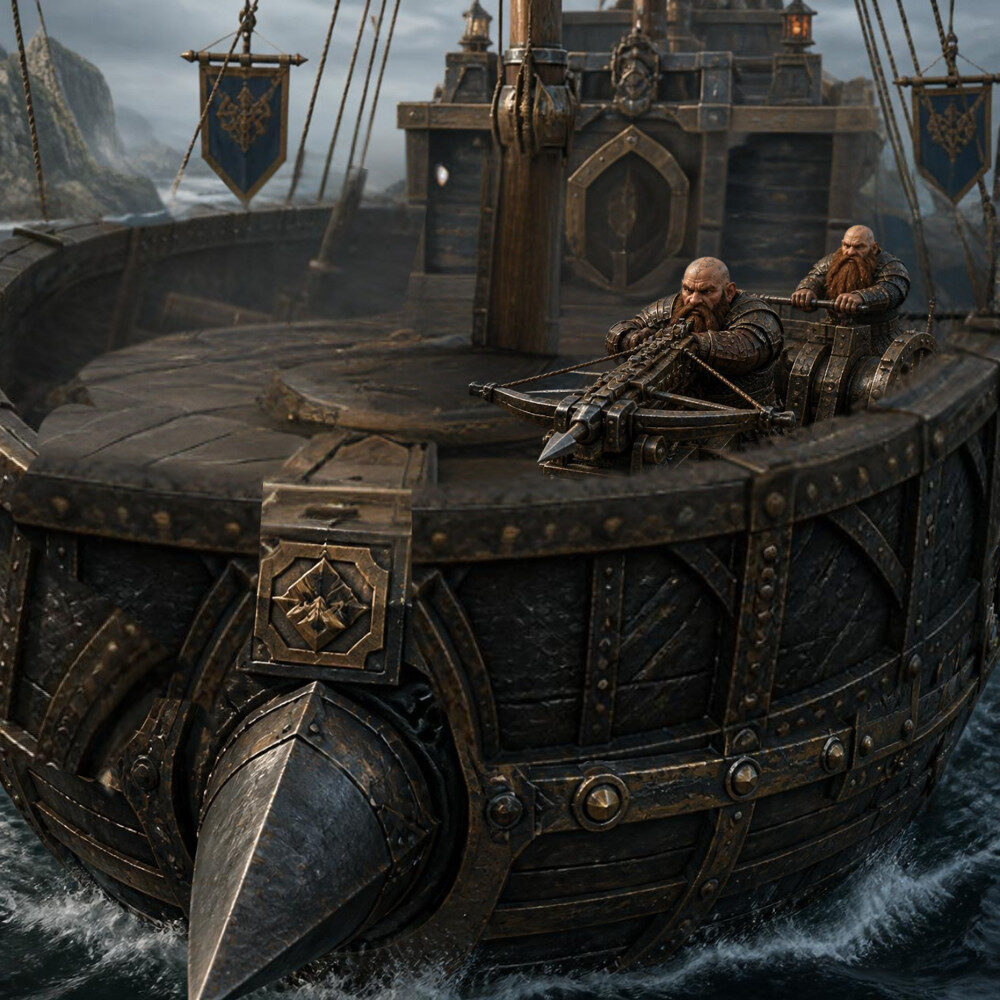
Dergul quickly shot his gaze back in front of him, down the four-foot steel bolt set in the groove of the heavy, mounted crossbow he had been left in charge of. The heavy wooden tiller with all the iron and brass parts weighed a good eighty pounds.
Light as a feather, he hardly reckoned it needed to be mounted. The oak shaft that supported the weapon made it pretty much weightless, and the rotating bronze joint on the deck of the ship beneath the shaft made aiming and holding the crossbow steady extremely easy. He supposed the mounting was a good idea after all.
“Stay focused,” the paddle operator said gruffly.
“Shut your damn, dumb face oar boy,” Dergul replied in a calm tone, though anger bubbled beneath the surface. “I’m plenty focused.”
He looked past the conical head of the bolt, using the site ring a few inches in front of his face to put his mark a few feet ahead of his crew mates, who were on the other ship just ahead of the Lugnaught.
I should be over there with them instead of on this nanny nest, thought the veteran warrior.
He glanced over his shoulder, subtly to avoid hearing more out of the paddler, to where Gulgiob lay. Motionless with his nose and his toes pointing to the sky, the fallen dwarf had two long arrows protruding from his thick beard, in the middle of his torso just under the breastbone.
Dergul hated to see his friend killed. He hated more that it had been a hobgoblin archer instead of a more worthy enemy, perhaps a troll or Vrakgem. Most of all he hated that his friend had failed to avoid the arrows because it left him on the latter’s post while the rest of the crew were on board the other ship cracking hobgob skulls open.
“Will you watch your post dammit?” the dwarf at the paddle lever said.
Dergul returned his eyes to the site ring. A wave of hot rage rolled over him and he almost abandoned his position to go deal with the loudmouth paddler whose name he didn’t even know. Exhaling evenly he turned the crossbow – technically referred to as a deck bolter – to his right, keeping it ten or so yards ahead of the dwarves on the other ship.
Ten dwarves, their bald scalps barely visible over the bulwark, moved along the long forecastle wall towards the main deck. Armed with hammers or axes, each dwarf held a small, square shield of solid steel in front of him.
Dergul reached the end of the forecastle wall with the site ring and was nearly startled – not quite but almost – to find a quartet of hobgoblin fighters moving along the wall perpendicular to his crewmates. They would reach the corner a couple of seconds before the dwarves and thus have a good two seconds to set their weight to strike the first dwarf who made the turn.
The dwarf on the nanny nest immediately pressed the deck-bolter’s trigger and released the bolt. In the same movement he bashed the little gong hanging off the left side of the crossbow’s tiller to signal his comrades that he was shooting ahead of them.
The dwarves on the other ship stopped dead in their tracks.
The bolt hit the first hobgoblin square in the chest and went right through. Dergul heard both the impact and the hobgob’s heavy grunt, as well as another grunt and a curse word in goblin from behind his first kill.
“That’s three. Good shot.” The paddler had suddenly appeared next to Dergul.
The dwarf lowered the small scope he’d used to watch the bolt score and returned to the paddle lever, giving it a nudge. The enormous wheel at the stern of the Lugnaught began to crank in reverse, shifting the craft backwards slowly.
Dergul shook his head. He cranked the winch on the side of the deck-bolter that simultaneously drew the string back and rolled another bolt into place from a ledge on the right side of the tiller. Three hobgoblins were down along the forecastle wall, the fourth sped across the deck towards the ship’s stern, ducking behind a massive cargo crate. He checked the quiver tray to see two more bolts remaining.
Gulgiob had killed nine hobgobs before he got pinned. The other bolter had put at least a handful down.
Dergul eyed the other weapon mounted on the deck bitterly. Currently unmanned, it’s operator had boarded the other ship with the rest of the crew. The boarding crew had dealt with another half-dozen hobgoblins atop the forecastle where they’d landed after the boarding lift had gently tossed them over onto the other ship.
That’s at least twenty done. A ship that size probably has a crew of eighty, maybe more. The rest must be below deck.
“There’s probably another fifty of them down there,” said the paddler as he nudged the ship forward at a slight angle.
The paddle wheel whirred and splashed as the ship straightened back up, it’s bow aligning with the center of the other craft’s main deck. Dergul’s deck-bolter sat thirty feet back from the Lugnaught’s forecastle platform – little more than a triangular deck for fighters to stand on – and offset to the port side.
He lined his site ring up with the large crate the hobgob had vanished behind. An ire grew within him as it occurred to him the other dwarf may have just read his mind.
Don’t worry over that. Stay focused.
Dergul’s neck muscles tensed. He wasn’t sure if he had just thought that or if someone else had spoken the words into his mind.
The dwarves on the other ship had moved onto the main deck.
“Something’s rotten,” he heard one of them remark.
“Stinks like a dead horse,” said another.
Cautiously they crept along close to the ship’s port side, checking behind a stack of crates then pausing. The party leader raised onto his tiptoes to look back to the Lugnaught; hid eyes, big nose, and bald head were clearly visible over the railing.
Dergul froze. He knew where the hobgob had gone but couldn’t remember the hand signals needed to convey the information to other dwarf.
The paddler stood next to him again, looking across the water at the other dwarf. He nodded slowly.
The dwarf on the hobgoblin ship nodded his understanding then turned to whisper-bark something to the other dwarves. The boarding party turned their attention to the large crate on the starboard side of the main deck.
Clearly the paddler had just conveyed information to the boarding party leader. A knot grew in Dergul’s stomach.
He glanced quickly at the tattoo on the paddler’s bald head – a stylized sun and moon connected by a circle that ran through both. He returned his attention to the site ring and placed it over the large crate the boarding party was approaching.
Some kind of damned mystical nonsense, maybe a psion order, He thought regarding the tattoo on the paddler’s scalp.
He silently rebuked himself for not realizing this sooner. The tattoo was unlike any clan mark or Duarden military insignia he had seen before, but Dergul had seen many unusual things since he’d arrived in the Duarden port city of Gedgidga and initially thought little of the odd tattoo.
I need to stay focused.
“Was that me or you dammit?” he asked over his shoulder, not taking his eye off the site ring.
His ire mounted. His muscles tensed and he involuntarily clenched both firsts.
Just as Dergul was about to demand the other dwarf answer him he felt a wave of complete serenity wash over him. His muscles relaxed. His anger evaporated.
Another chilly breeze sprayed salty water droplets onto the Duarden’s bald head. This time he didn’t shiver but found the spray pleasing. The sound of the sails on the other ship, flapping and rustling reminded him of the day he walked onto the pier at Gedgidga to find the Lugnaught, having heard the captain was looking to hire a new fighter or two.
With absolute clarity he saw the dwarves on the other ship fanning out on their approach to the large crate. He hadn’t registered previously how tall the wooden box stood over the rest of the cargo; a good twelve feet it loomed.
“How goes it?” he heard the captain ask the paddler, having returned from below deck.
The paddler didn’t reply, and yet the captain said, “He still behind it you think?”
Silence.
Then the captain gave an affirmative grunt and asked, “How’s he doing?”
The paddler said nary a word.
“Good,” the captain replied.
Still calm as a dwarf in a deep tunnel with a pickaxe in one hand and a lump of ore in the other, Dergul now knew with a certainty the paddler was a psion. He also knew the other dwarf’s name was Gorribdon.
A metallic clank from the other ship captured Dergul’s attention. He registered movement behind the large crate and realized a large chain running from the base of the ship’s mast to the big crate had lost tension. It slumped to the deck with a heavy, metal thud.
He heard a hobgoblin voice say something he couldn’t translate, along with the goblin word for “free” or “loose”.
Then came a deep grunt and a snort, followed by a deeper, louder grunt. It sounded like a giant bull.
The dwarves on the deck of the hobgob ship backed away from the large crate, shields out in front and weapons at the ready.
The front of the tall, wooden crate shattered with a loud cracking sound. Wood fragments and planks splintered in all directions.
An immense figure took a single step out of the crate and onto the deck. Standing ten feet tall with shoulders four feet across the top of an overly-muscled, barrel-shaped torso, the ogre raised an arm to shield its eyes from the daylight.
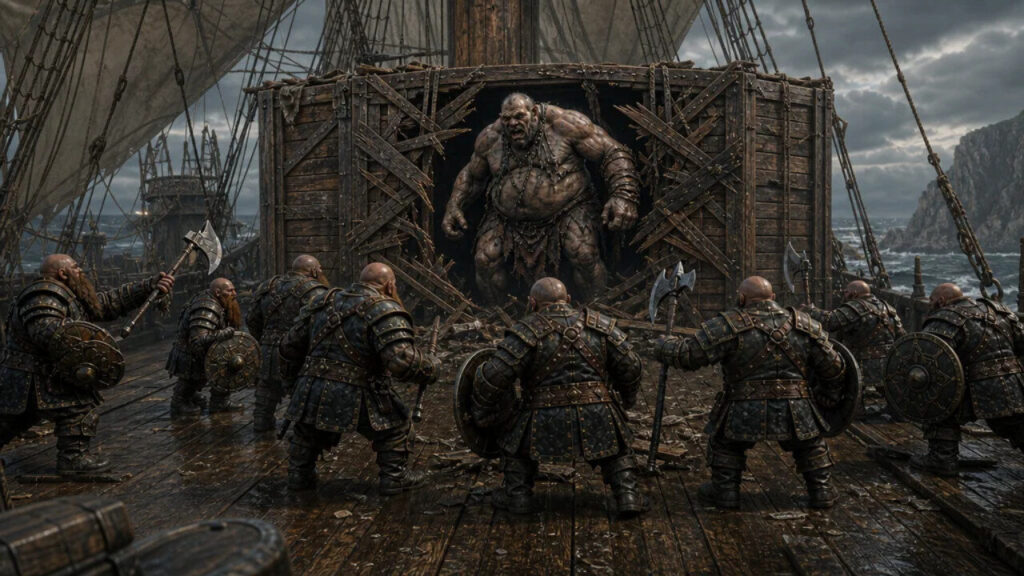
A chorus of grumbling curses rose from the boarding party as several dwarves brought their shields up in front of their noses and mouths. One dwarf turned away from the crate and heaved.
“Gods of the Mountain they stink!” another complained.
Dergul pressed the trigger and let his second bolt fly, smacking the gong at the same time and immediately working the crank wheel to draw the string back and reload. The steel bolt sailed true, hitting the ogre in the center of its torso and passing completely through the monster to impact the deck behind it.
The colossal figure went limp and dropped to both knees, cracking deck planks as it fell. It posted with both hands to keep itself from falling flat on its face and lurched forward to begin rolling its weight forward and stand back up.
An axe thrown by one of the boarders split the top of the ogre’s skull and stuck in place. Seemingly unbothered by this, the monster lumbered back up to its feet just as two dwarves rushed in from its left and right.
The deck-bolter clicked at the end of the winch’s reset.
Dergul saw the ogre catch the dwarf on its left with a swooping backhand strike that lifted the boarder off his feet and sent him tumbling end-over-end into a stack of crates twenty feet away. He put the ring high in the center of the creature’s chest and pressed the trigger.
Another breeze whipped across the Lugnaught’s deck, bringing with it a foulness like Dergul had never before experienced. The stench didn’t overwhelm the dwarf, it overran him, striking his face and eyes and plunging itself deep into both nostrils.
“Dommeg’s anvil!” he cursed and staggered back a full step and half of another.
He didn’t see his third bolt puncture the ogre just to the left of its breastbone and sail clean through, exiting just under the opposite armpit.
The dwarf gasped for air, only succeeding in bringing more of the ogre’s stench into his lungs. He stomped hard and rushed over to the bulwark to vomit like an upside-down volcano over the side of the ship.
This brought some relief, but the horrid odor remained.
“Dommeg’s anvil!” he shouted louder than before, as if taking the god’s name in vain at a higher volume might hasten some kind of relief.
The captain and paddler both laughed.
“Good shot,” Gorribdon remarked. “That one dropped him for good.”
Dergul was pleased to hear this, but also alarmed by the reminder that he was in the middle of a fight. His mind raced; he needed to get back on the deck-bolter but he couldn’t possibly focus and aim in his present state.
His stomach quivered again and his muscles felt weak all over. He took several sharp breaths with his mouth, being careful not to bring any air through his nose.
The captain’s heavy hand slapped him on the back. “I’ll cover your post. Get in the aftercastle and wash that stench away with a brew; the dark amber works best.”
Somewhat bewildered but not about to turn down the offer Dergul half-staggered to the aft castle door and went inside.
Half an Hour Later
The Lugnaught’s paddle wheel hummed steadily as the ship backed away from the burning hobgoblin vessel. Fourteen dwarves, the crew of the small vessel minus the two that were killed in the fight, stood on deck watching the other ship burn.
The wind had picked up a little. The flag on a pole in the Lugnaught’s stern whipped and flapped; the emblem on the linen was a hammer crossed with an anchor over a diamond.
The hobgoblin ship’s stern was entirely covered by the blaze and flames crept up the mast, consuming the large central sail and lighting the smaller triangular sails on each side. Rather than descend below deck to engage fifty hobgoblins the boarding crew had elected to use their burning oil flasks to ignite the hostile craft and quickly return to the Lugnaught.
Burning hobgoblins, resembling torches with arms and legs, could be seen spilling out of the blaze and into the ocean. A few hobgobs who were not ablaze could be seen lowering a lifeboat at the bow of the doomed ship.
Dergul wondered if he should put a few bolts across the water and into those hobgoblins who, most likely would have the lifeboat in the water and be aboard before the fire got to them.
“Those bolts are Korvelan steel,” Gorribdon pointed out. “Expensive; not worth trading for five defeated hobgobs.”
Dergul nodded, then realized he hadn’t spoken his question aloud. He glared at the other dwarf, taking a good look at the tattoo on the latter’s crown before locking eyes with him.
“I didn’t need to read your mind to know what you were thinking just now,” the psion offered.
“And before?” Derugl demanded indignantly.
“We were in a fight,” Gorribdon shrugged, idly stroking his beard. “There’s no Duarden law against using my talents as I see fit.”
“How about common courtesy?” Dergul shot back. “You just reach into another’s mind whenever you like?”
“No,” the psion replied. “I respect everyone’s right to a private place between their own ears.”
“Sure you do,” Dergul growled.
“It’s true.” The captain walked over to the pair of Duarden and assumed command of the tense conversation.
His face stern and weathered below his bald scalp, which bore the square, runic emblem of his clan, the captain pointed to another squarish rune on the psion’s right arm.
“That mark was placed by my personal wonder-worker back in Gedgidga. It won’t allow Gorribdon here to enter or read the mind of another dwarf employed by the Maritime Diamond Hammer company without a legitimate reason, such as communicating In the heat of a fight or rendering aid when someone is distraught.”
Dergul found this new information somewhat comforting, but remained irate about the idea of another dwarf rummaging through his thoughts earlier that day.
“How was your turn on the deck-bolter?” The captain moved on to another subject, considering the former matter resolved.
“I reckon I managed, captain,” Dergul answered, adding “I should have been a little quicker; shouldn’t have let that brute take a swipe of Mardle like that.”
“Mardle is tough, not even a broken bone,” the captain offered. “You’ll be quicker the next time you’re on that post.”
“Aye, captain.” said Dergul, his heart sank at the thought of being relegated to the nanny nest during future engagements.
“You did well,” the captain continued.
“Thank you,” Dergul nodded.
“Do you know why I stuck you on the deck bolter for this engagement?” asked the ship’s officer.
Dergul didn’t know with a certainty, but answered truthfully. “I wondered if maybe you aren’t sure I can handle myself in a melee.”
The captain shook his head dismissively. “I’m a couple centuries older than you lad, I know what I’m looking at when I watch a fighter cross the deck to lock forearms. Can tell pretty much by the way a dard holds his mug what his poise in a dust up will be, or by the way he laces his boots whether or not he’s got a good square jaw for the fight ahead. I know you can handle that Dariftzhalgen axe you brung with you.”
Dergul’s eyes widened before he could catch himself.
Gorribdon chuckled.
“Oh yeah.” The captain nodded enthusiastically. “I can spot the work of them Halgen smiths a mile away. The deep iron from under the mountains on Melithandros has a distinct grain pattern after it’s been forged.”
Dergul fidgeted subtly. An awkwardness sat upon his shoulders like a great weight in that moment.
“You’re twitchin’ a little because I know you were fibbing when you told me you were from Ikagrled,” the captain pointed out. “Don’t. Where a dard comes from is his or her own business; my charge is how you handle yourself while in my employ.”
Dergul’s relief must have been visible, as both the captain and Gorribdon exchanged knowing smiles.
“For what it’s worth you pull off the accent well enough,” the captain added. “Most would take you at your word as an Ikag dard without another thought.”
Dergul laughed, for he had been told by others he’d picked up the local accent from his time in the dwarven city of Ikagrled.
“It was about patience,” the captain said. “Not saying you don’t have any, but a life at sea or on ship is much different from a life in the mines or time spent in a big urban center like Ikagrled. Takes a special kind of patience out here.” He waved his hand at the open sea.
The dwarf manning the paddle and rudder turned the Lugnaught away from the burning hobgoblin vessel then began to move steadily back towards the strip of land visible on the northern horizon.
Dergul began to understand the events of the day with a more grounded perspective. He had noticed the difference in his own tempo and that of the Lugnaught’s crew but hadn’t given it serious thought.
Where he was antsy and considering the next moment, his new comrades often seemed more complacent with the circumstances of the immediate present. He rocked side-to-side on his heels before a fight, whereas the others had the demeanor of dwarves waiting to be served chow when they weren’t especially hungry.
Perhaps the gears of his patience could use an adjustment; a little oil and refinement of the pitch point. He felt the sea’s rhythm settling into him — slower, steadier, like a gear finally catching.
“Why in two hells were they toting that ogre?” a dwarf from the group behind the captain broke Dergul’s moment of contemplation.
“We know these hobgobs were headed back to Dirus Foedus,” the same dwarf continued. “They must have thousands of ogres in those mountain ranges.”
“I heard they had to cull a bunch,” another dwarf responded. “Ogres were making some trouble along the southern canyon ridge, had to clean out a couple thousand or so.”
“Where’d you hear that?” another dwarf chimed in.
“A Sakal shipwright told me,” the second dwarf explained. “Said he’s got a cousin works as a sellsword for some warlord in Bruk-Thar.”
“An orc boatmaker,” said yet another dwarf. “That’s bound to be reliable information.”
“All know the ogres in the Marching Pillars grow bigger than their kind elsewhere,” the captain called over his shoulder, then turned to face his crew. “If I were a betting dard I’d wager they were taking that one back as breeding stock.”
This was surely a reasonable explanation. Coupled with the fact that none of the assembled Duarden had any interest in openly refuting their captain, it seemed to satisfy the crew.
“About time for some dark amber brew I’m thinking,” the dwarf who asked about the ogre in the first place pointed out.
“About right!” the dwarf who relayed the rumor he’d heard from the Sakal shipwright added his vote.
Enthusiastically, yet in no particular rush, the group of dwarves headed towards the aftercastle door. Exhaling evenly and taking in the moment, the salty breeze, the whirring of the Lugnaught’s paddle wheel, and the steady creaking of the deck underfoot, Dergul strolled over to join them.
“About right,” Gorribdon said to him as he slapped his shoulder.
Dergul smiled back at the psion and sometimes-paddler.